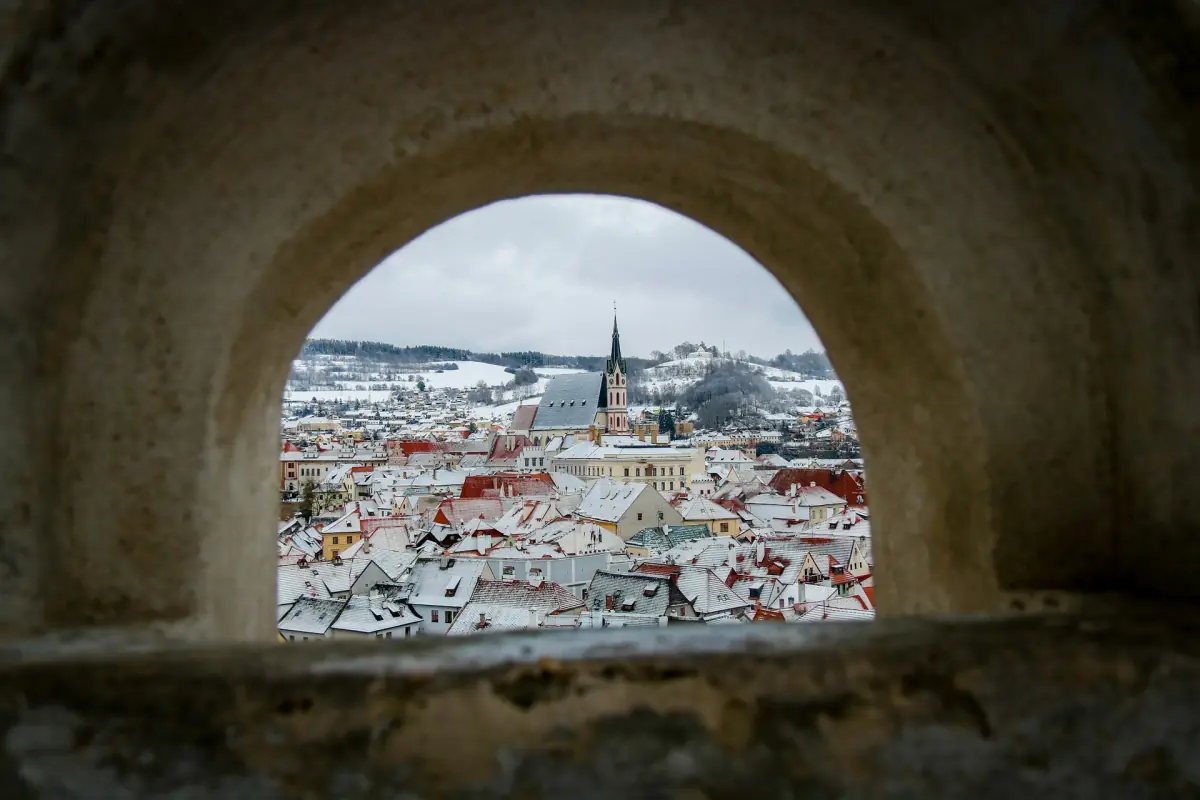
The history of Český Krumlov at a glance
Český Krumlov lies in a loop of the Vltava in South Bohemia. The first written record of the town dates from 1253. Three noble families shaped it over the centuries: the Rosenbergs, the Eggenbergs and the Schwarzenbergs. The historic centre with the castle has been a UNESCO World Heritage Site since 1992.
The German name Krumau is traditionally traced to the words Krumme Aue. The town has two historic parts: Latrán below the castle and the Old Town inside the river loop on the other side. If you want to see the rooms that these families built, read our guide to Český Krumlov castle tours and tickets.

Timeline from 1253 to 1992
The main dates in one table.
| Year | Event |
|---|---|
| 1253 | First record of the town |
| 1302 | The Lords of Krumlov die out and the castle passes to the related Rosenbergs |
| 14 August 1555 | Latrán and the Old Town are united under William of Rosenberg |
| Second half of the 16th century | Main Renaissance building phase |
| 1601 or 1602 | The estate is sold to Rudolf II, and the Rosenberg residence ends in 1602 |
| 1622 | The Eggenbergs take over |
| 1719 | The Schwarzenbergs succeed to the estate |
| 1947 and 1950 | Property passes to Bohemian regional ownership in 1947, then to the state in 1950 |
| 1992 | The historic centre is inscribed as a UNESCO World Heritage Site |
For most visitors, the Rosenberg and Eggenberg eras explain what they will see. Route I leads through the Renaissance and baroque apartments, while Route II shows 19th-century rooms and the Schwarzenberg portrait gallery.
Our picks: history walk
A guided walk built around the Baroque theatre, with a visit inside.
Hand-picked tours, booked through GetYourGuide. Prices are indicative starting prices in euros (as of October 2026). Tap a tour for live availability and the current price in your currency.

Tours and day trips to Český Krumlov
Castle visits, guided town walks and day trips from Prague, with live prices and availability.
The Rosenbergs and the Renaissance
1302 to 1602.
After the Lords of Krumlov died out in 1302, the castle passed to the related Rosenbergs. They kept it as their residence until 1602. The Renaissance building phase falls mainly in the second half of the 16th century.
On 14 August 1555, Latrán and the Old Town were united under William of Rosenberg. The two parts of the town, one under the castle and one inside the river loop, still read as one historic centre today. The estate was sold to Rudolf II in 1601 or 1602.
Eggenbergs and Schwarzenbergs
1622 to the 20th century.
The town passed to the Eggenbergs in 1622. The baroque remodelling of the castle took place under Johann Christian I of Eggenberg. The Schwarzenbergs followed in 1719, and Joseph Adam of Schwarzenberg carried the development further.
The baroque age left the castle theatre, which is among the most completely preserved baroque theatres in the world, with its stage, machinery, sets and costumes. Visits require a reservation. Read more in our guide to the baroque theatre at Český Krumlov castle.
From a private estate to state property
1947 and 1950.
The change of ownership in the 20th century happened in two steps. In 1947, the Schwarzenberg property passed to Bohemian regional ownership. In 1950, after the regional administration was dissolved, it became state property. These are two separate legal acts.
UNESCO World Heritage Site
The listing and what it covers.
The historic centre of Český Krumlov was inscribed in 1992 under criterion (iv). The inscribed area covers 51.65 hectares, and the buffer zone covers 850.76 hectares. The status applies to the historic centre and the castle complex. It is not an admission ticket and does not mean that every interior is open all year.
Five-Petalled Rose Festival
The historic festival in the town centre.
The Five-Petalled Rose Festival takes place in the historic centre. The organisers announce the next festival for 18 to 20 June 2027. Dates change from year to year, and road closures from earlier years do not automatically apply again.
Fix your dates first if you plan around the festival, then see where to stay in Český Krumlov for areas and the car rules.
Where history is visible today
Four places to start.
The castle routes
Route I covers the Renaissance and baroque apartments with St George's chapel and the Masquerade Hall. It lasts 55 minutes, with at most 45 people. Route II shows apartments of the 19th century and the Schwarzenberg portrait gallery.
St Vitus church
The late Gothic church was built between 1407 and 1439. The upper part of the tower is neo-Gothic and dates from 1893 and 1894. The address is Horní 156.
Egon Schiele
Schiele's mother was born in Krumlov, and he knew the town from childhood visits. He stayed from May 1910, returned in May 1911 with Wally Neužil and left on 6 August 1911 after conflicts with locals.
Egon Schiele Art Centrum →The old town
The main square, Náměstí Svornosti, is the centre. The streets, bridges and museums are described in our guide to things to do in Český Krumlov.
Plan the rest of your trip
Where the history is on show.


History of Český Krumlov: frequently asked questions
When was Český Krumlov founded?
The first written record of the town dates from 1253. The castle passed to the Rosenbergs in 1302.
Who owned Český Krumlov castle?
The Rosenbergs until 1602, then the estate was sold to Rudolf II. The Eggenbergs took over in 1622 and the Schwarzenbergs in 1719. Since 1950 the property has belonged to the state.
When did Český Krumlov become a UNESCO site?
In 1992. The inscription covers the historic centre, with an inscribed area of 51.65 hectares and a buffer zone of 850.76 hectares.
What does the name Krumau mean?
Krumau is the German name of the town. It is traditionally traced to the words Krumme Aue. Do not confuse it with Moravský Krumlov, a different town.
When is the Five-Petalled Rose Festival?
The next festival is announced for 18 to 20 June 2027. Check the current programme before you plan a trip around it.